A simple jig for repeat cuts
Measuring twenty pieces produces twenty slightly different lengths; setting a stop once produces twenty identical ones.
Any project with repeated parts - shelf uprights, fence pickets, drawer sides - rewards the twenty minutes spent making a jig far more than it rewards care with a tape measure. Cumulative error is the problem: each measurement carries a small reading error and a small pencil-line error, and those errors do not cancel out.
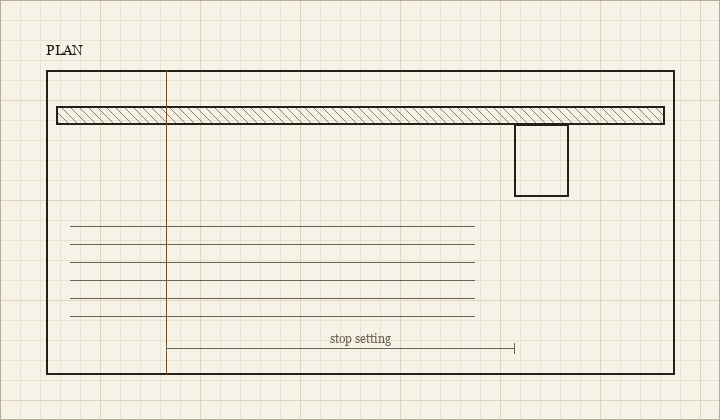
The jig is a flat base with a fence fixed square to the saw's path and a stop block clamped at the required distance. The first cut through the assembled jig makes a kerf, and from then on the edge of that kerf is the cut line. There is nothing to interpret and nothing to line up by eye.
Squareness of the fence is the only critical setting, and it is worth checking with the five-cut method rather than a square. Cut a test piece, flip it, cut again, and measure the two ends of the offcut. Any error in the fence shows up multiplied, which makes a tiny misalignment measurable.
Set the stop from the kerf, not from a ruler laid on the base. A stop set with a tape carries the same reading error the jig is meant to eliminate. Cut one piece, measure that piece, adjust the stop and cut again, and the third piece is usually exact.
Keep offcuts clear of the stop. A chip of waste trapped between workpiece and stop block adds its own thickness to every subsequent piece, and because it is small it will not be noticed until the parts are assembled. A shallow relief cut at the base of the stop gives dust and chips somewhere to go.
Label the jig with what it was set for and leave the stop in place if there is a chance of needing another part later. A replacement part cut months afterwards from an unchanged jig matches; one cut from a fresh measurement rarely does.
A jig is not a precision instrument and does not need to be beautiful. Scrap sheet, a straight offcut for the fence and two clamps do everything described here.