Filling and sanding end grain
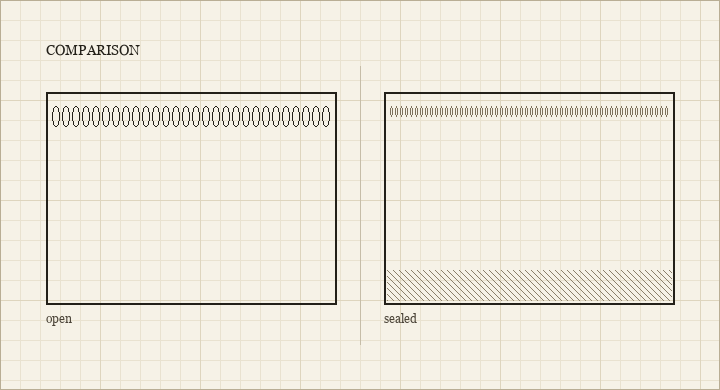
End grain behaves like a bundle of straws, and every problem with finishing it follows from that.
Cut across the fibres and what is exposed is thousands of open tube ends. They take up finish far faster than a face does, which is why a stained shelf end goes almost black while the face stays the intended colour, and why paint sinks into a cut edge and leaves it dull.
Sanding is the first correction and it works in the opposite direction from instinct. Where a face is finished at a medium grit, end grain benefits from going two or three grits finer. The finer abrasive burnishes the cell ends partly closed and reduces the rate at which they absorb.
Work through the grits in order rather than jumping. Skipping from coarse to fine leaves the coarse scratches in place with a polished surface on the ridges between them, and those scratches will be the most visible thing on the piece once a finish goes on.
A thinned coat of the intended finish, applied to end grain alone and allowed to dry before anything else happens, evens out the absorption. On painted work, a thinned coat of the same paint is enough. Purpose-made sealers exist and are useful, but the principle rather than the product is what matters.
Filler on end grain needs to be pressed in across the fibres, not wiped along them. Wiping along the cut leaves the tubes full at the surface and empty below, so the repair sinks as it dries and reappears a day later as a row of small pits.
Raise the grain deliberately on anything that will meet a water-based finish. A damp cloth over the sanded surface lifts the fibres; letting it dry and cutting back lightly with the finest grit means the finish itself has nothing left to raise, and the first coat stays smooth instead of turning furry.
None of this applies evenly across species. Open-pored timbers show every one of these effects strongly, close-grained ones barely at all, and the only way to know which you have is to try the sequence on an offcut first.