Cutting in without a wobbling line
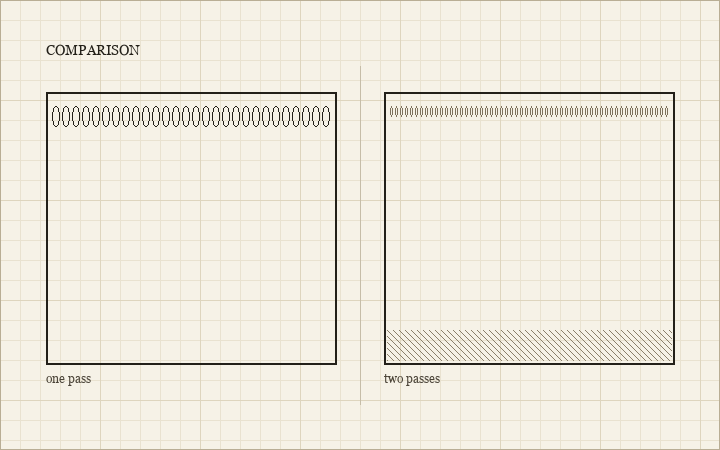
A straight cut-in line is a two-pass operation, and almost nobody manages it in one.
The usual failure is to load a brush, aim it at the junction and try to steer. The bristles carry too much paint at the start of the run and too little at the end, so the line is thick and wandering for the first hand span and dry and skipping by the last.
Load the brush properly first. Dip no more than a third of the bristle length and tap each side against the inside of the tin rather than dragging across the rim. Dragging strips the outside of the brush and leaves the middle full, which is exactly the wrong distribution for edge work.
The first pass goes on about a finger's width below the line. It is not trying to be neat; it is putting the bulk of the paint on the wall and spreading it out so the brush is carrying a controlled amount for the pass that counts.
The second pass turns the brush up on its edge and runs it along the junction. Move the whole arm from the shoulder rather than the wrist, keep the elbow tucked in, and run as far as the arm reaches comfortably before repositioning. Stopping and starting in the middle of a run leaves a mark; overlapping a previous run by a few centimetres while it is still wet does not.
Speed helps. A slow brush lets the film start to set at the start of the run, so that the bristles drag through skinning paint and leave ridges. The line should be laid in at the pace of ordinary handwriting.
Where the junction itself is uneven - and in an older house it usually is - the brush follows the ceiling rather than a ruler. An edge that runs parallel to a crooked junction reads as straight. One that is genuinely straight, against a junction that is not, reads as a mistake that widens across the room.
Masking tape is not a substitute. On a textured or previously distempered surface it lifts the old coating when it comes off, and paint wicks under the edge wherever the surface is not perfectly flat. It has a place on woodwork and glass, and very little on a plastered junction.