Hanging a run of floating shelves
The bracket is invisible, so every error in the drilling is not.
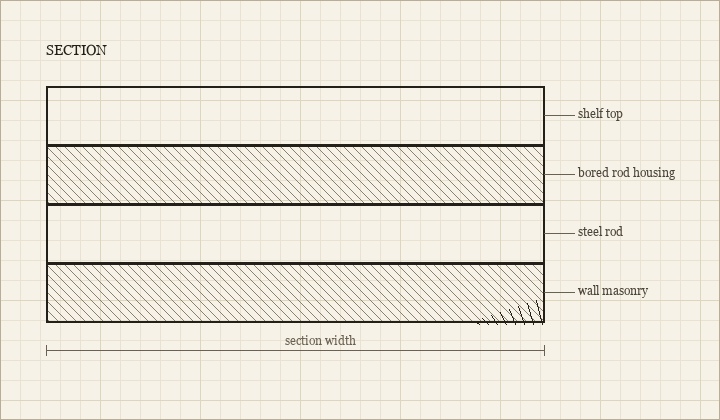
Concealed fixings work by cantilevering a steel rod out of the wall and sliding the shelf over it. All the load runs through a short length of rod and the wall it is anchored into, which means the wall has to be genuinely solid and the holes have to be genuinely straight.
Test the wall before buying anything. A masonry wall that sounds solid at the fixing height and takes a drill without sudden give is the only good case. On a hollow wall the fixing has to land in the timber studs, which fixes the shelf positions rather than letting you choose them, and that constraint decides the whole layout.
Drill the wall holes with something that guarantees the angle. A drill held by eye wanders a few degrees, and a few degrees over the length of a rod becomes a shelf that tips forward or fights against its neighbour. A simple jig or even a block of scrap with a square hole through it will keep the bit honest.
Bore the shelf from the same jig, clamped against the shelf back. Transferring positions by measuring from the wall to the shelf is where most runs go wrong, because it introduces two independent sets of measurements that have to agree within a millimetre or two.
Dry fit one rod at a time. Sliding a shelf onto three rods at once when the third is slightly out means levering, and levering on a concealed fixing bends the rod or opens the hole in the wall. Fit the first, check, add the second, check again.
Depth matters at both ends. Too little rod in the wall and the fixing pulls out under load; too little in the shelf and the shelf pivots on the end of the rod and splits along the grain. Marking both depths on the bit with tape is cruder and more reliable than remembering.
Finally, be honest about what the shelf is for. Concealed fixings suit light and medium loads over modest spans. A long run intended for a full set of books is a job for visible brackets, and no amount of careful drilling changes that.