Paving that drains, and what happens below
Everything about paving that fails is decided below the surface, before a slab is touched.
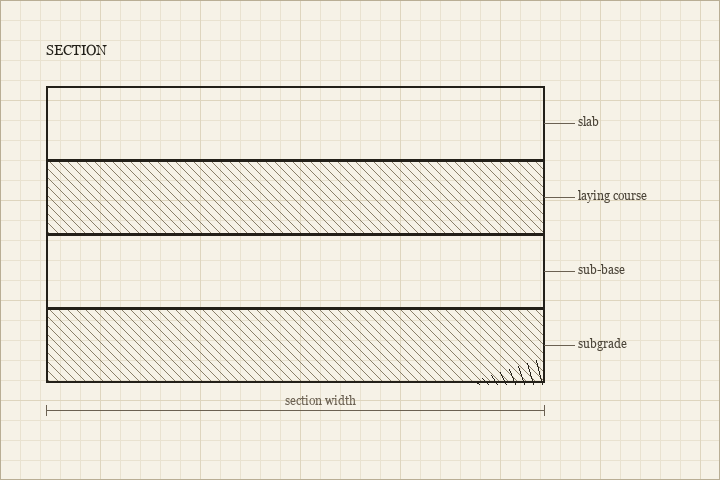
The visible layer is the least important one. A compacted sub-base of adequate depth, laid on ground that has had the soft material dug out of it, is what stops the paving sinking in wheel tracks and along the edges.
Depth depends on what the ground is and what the paving carries. Foot traffic over firm subsoil needs relatively little; anything carrying a vehicle, or laid over soft or made-up ground, needs considerably more. Digging out until the ground stops giving under a heel is a cruder test than a survey and a much better one than guessing.
Compact in layers. Tipping the whole depth in at once and running a plate over the top compacts the top few centimetres and leaves the rest loose, which is indistinguishable from a good job until the first winter.
Set the fall before laying anything, and set it away from the house. A fall of roughly one in eighty is enough to shed water and shallow enough that nobody notices it underfoot. Running string lines at the finished level, checked with a level and a tapered gauge, is the simplest way to hold it across an area.
Keep the finished surface well below any damp proof course in an adjoining wall. Paving that bridges it channels ground water into the wall, and the damage appears inside the building rather than on the paving, which makes the cause easy to miss.
Lay on a full bed rather than on dabs. Spot bedding leaves voids under the slab, the slab rings hollow, and in time it cracks across the unsupported middle or rocks under a corner.
Edges restrain everything. Without a haunched or otherwise restrained edge, the bedding layer migrates sideways over years and the outer slabs drop and open joints that then let more water in.