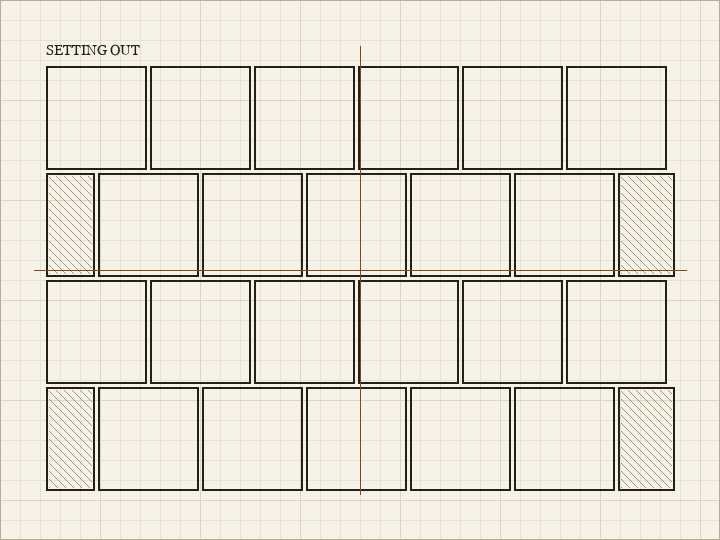
Setting out tile from the centre
Start tiling at a corner and the far wall decides how the job looks. Start in the middle and you decide.
The first tile placed sets every other one, so it is worth an hour of dry laying before any adhesive is mixed. The aim is to arrange the cuts, because the cuts are what people notice: a room with a full tile at one wall and a two-centimetre slither at the other reads as badly planned even to someone who has never laid a tile.
Snap or chalk two centre lines at right angles and dry lay a row out from each, spacers included. The gap left at the wall is the cut width. If that cut is less than about a third of a tile, shift the whole grid by half a tile and the cuts at both ends become comfortable.
Check the room's squareness at the same time. Measure the two diagonals of the space; if they differ, the walls are not parallel and the cut along one wall will taper. A tapering cut is far less objectionable at the least visible wall, so this is the moment to decide which wall gets it.
Doorways override the maths. A cut tile that runs across a threshold, where the eye is level with the floor and the material changes, is the most visible cut in the room. Arranging a full tile to land at the threshold is usually worth accepting a less tidy arrangement elsewhere.
On walls, the same logic applies vertically. A full tile at the top of a splashback and a sliver at the worktop looks accidental; a full tile at the worktop, where the eye sits, with the cut up at the top under a cupboard, looks intentional.
Mix only what can be laid while it stays workable, and keep the notched trowel at a consistent angle so the ribs of adhesive are the same depth everywhere. Varying the angle across a floor produces tiles sitting at slightly different heights, and the difference is felt underfoot long before it is seen.
Take spacers out before the adhesive is fully hard. Left in too long they have to be dug out, which chips the glaze at exactly the point where the grout is thinnest and the damage is hardest to hide.